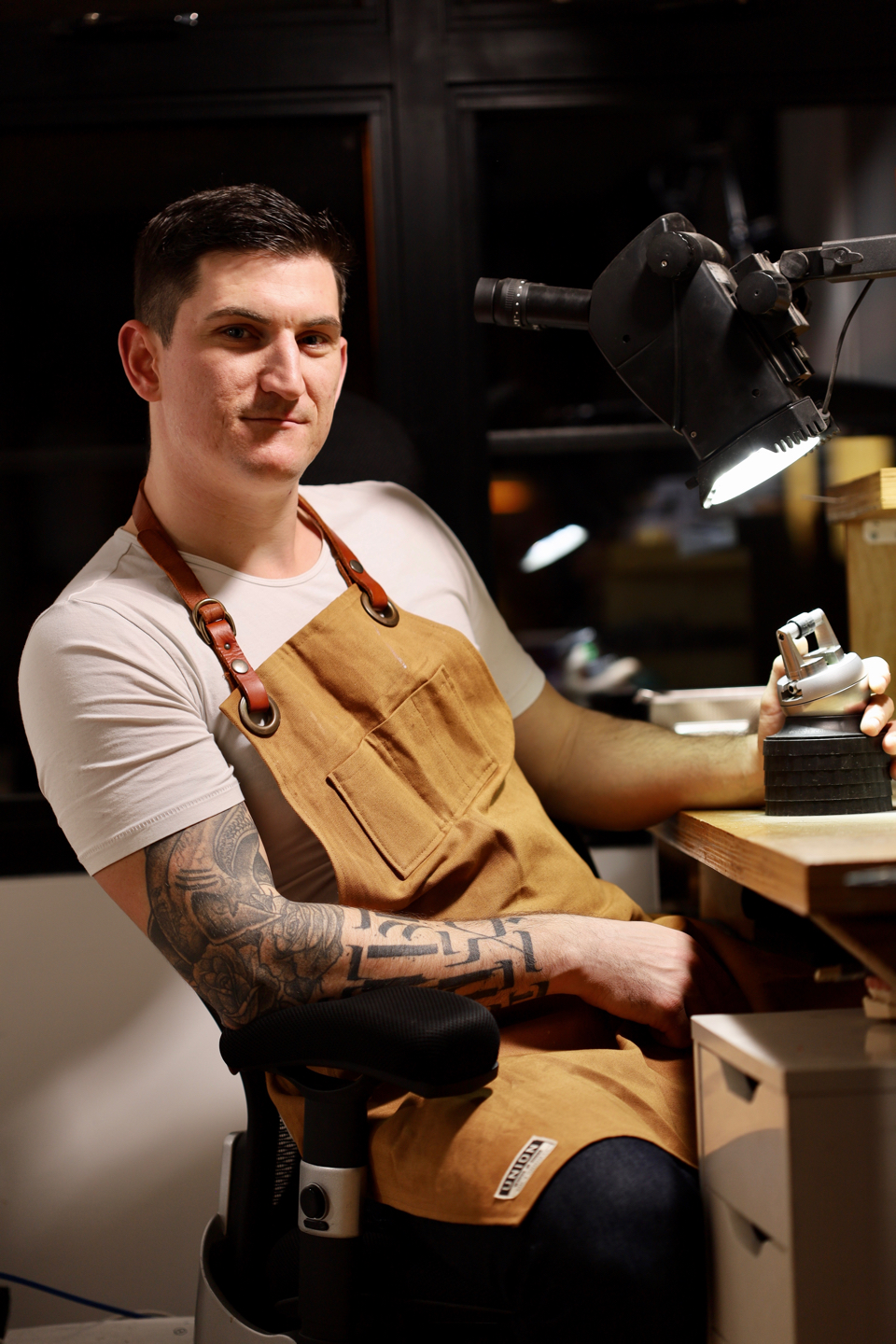
I didn't come from jewellery. I came from oil refinery construction in the Canadian north. Nobody looked at my CV and said "natural diamond setter." I had no connections in the trade, no family in the industry, no mentor who knew the right doors to knock on.
And yet, within a few years of deciding this was what I wanted to do, I was setting stones at Graff Diamonds in London. The path from zero to working at the highest level in fine jewellery is not easy — but it is navigable. This article is about what that navigation actually looks like.
Why Most Beginners Plateau
Before we talk about progress, let's talk about stagnation — because the vast majority of people who start learning diamond setting get stuck at the same point, for the same reasons.
They learn enough to produce work that looks acceptable. The stones stay in. Nothing falls out in the first ten minutes. And then they stop improving, because nobody in their immediate environment can see the problems they're developing.
Here's the brutal reality: mediocre diamond setting looks fine to people who don't set diamonds. A stone slightly off-centre, a bead that's marginally inconsistent, a seat that's cut at the wrong angle — these are invisible to most jewellers and almost everyone else. The amateur eye doesn't catch them. Which means if you're only getting feedback from people who aren't setters, you have no idea whether you're actually improving or just becoming more confidently mediocre.
The setters who make it to a professional level are not necessarily more naturally talented. They're the ones who got honest feedback early, corrected their fundamentals, and built habits that scale.
The Foundation: Getting the Fundamentals Right
Every advanced setting technique is a refinement of the fundamentals. Seat cutting. Stone security. Bead formation. Polishing without damaging the work. These aren't the exciting parts — but they are the parts that determine the ceiling of your skill.
The mistake most self-taught setters make is rushing through the fundamentals to get to the more visually impressive techniques. They want to do pavé, so they skip straight to pavé, and they produce pavé that looks okay from a distance but wouldn't pass quality control at a serious studio.
Set a bezel well. Set a claw well. Understand exactly why the seat needs to be cut at the angle it needs to be cut at, not just that it does. These aren't prerequisites to get out of the way — they're the skills you'll rely on for the rest of your career.
The Progression: How Skills Build
Setting types have a natural progression from simpler to more demanding. Rubover (bezel) setting teaches you to cut seats accurately and understand stone security. Claw/prong setting teaches you about bearing angles and how different metals behave. Grain setting introduces you to bead-raising and the relationship between the metal and the stone. Pavé and micro-pavé demand all of the above, plus precision, plus speed.
You cannot shortcut this sequence. Each stage genuinely prepares you for the next. Students who try to jump to micro-pavé without proper grain setting foundations almost always develop problems — inconsistent bead height, stones not sitting flush, rows that drift out of line — that are very hard to diagnose and correct later.
Tools and Environment
Professional-level setting requires professional-grade tools. Not necessarily expensive in every case — but quality. Gravers that hold an edge, magnification adequate for the work you're doing, a work-holding setup that keeps your piece stable. If your tools are fighting you, your technique will compensate in ways you don't even notice, and those compensations become habits.
The same applies to your working environment. Good light. Proper posture. A bench at the right height. These things sound like minor details. They are not minor. Setters who develop back problems or eye strain early are working in poorly configured environments, not just unlucky.
Getting to Professional Standard: What It Actually Means
Professional standard isn't a fixed point — it varies by context. A professional standard for commercial fashion jewellery is different from a professional standard for high jewellery. But there are common elements: consistency, speed, and the ability to work to someone else's specification under pressure.
Consistency matters more than the individual best piece. A studio doesn't care that you can produce one perfect pavé row if the next three are inconsistent. They need work that's repeatable, reliable, and deliverable to a deadline.
Speed comes with practice. Not rushing — controlled efficiency. A good setter is fast not because they cut corners but because they've internalised the technique to the point where each movement is deliberate and economical. This takes time. It can't be faked. But it does come, with the right kind of practice.
The Online Education Question
Can you genuinely learn to set diamonds to a professional standard through online instruction? I'm asked this constantly, and my honest answer is: yes, but not from just any online content.
YouTube tutorials and forum posts will get you started, but they won't build a professional skill. What works is structured curriculum — instruction that's designed to develop skills progressively, with proper feedback mechanisms, taught by someone who actually works at a professional level and knows what the problems look like before they become habits.
The Microsetting Academy was built to do exactly this. It's the curriculum I wish I'd had access to when I was learning. If you're serious about developing this skill professionally, it's the most efficient path I know of.